


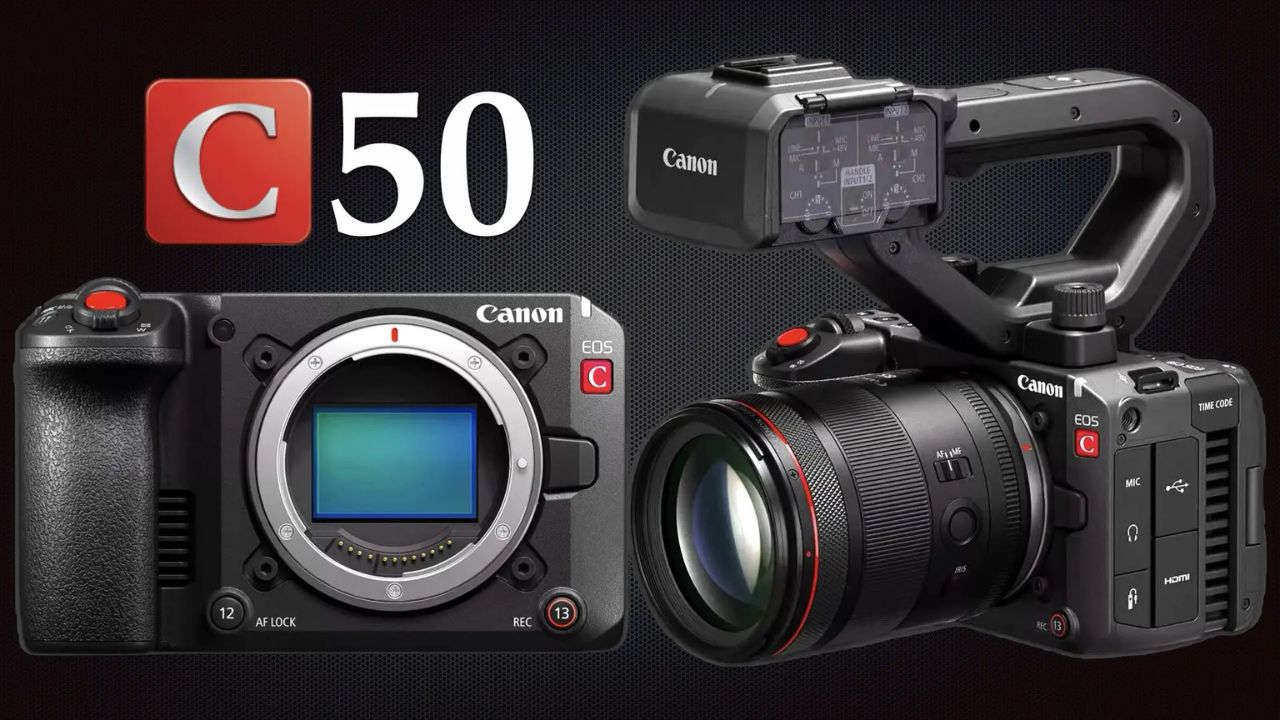
The Canon Cinema EOS C50 is generating significant buzz in the filmmaking community as rumors and leaks continue to surface. Positioned as a compact cinema powerhouse, the C50 seems designed to merge Canon’s acclaimed image quality with modern agile workflows. If the reported specifications prove accurate, this camera could reshape how independent filmmakers, documentarians, and hybrid creators approach professional video production.
Table of Contents
Compact but Powerful Design
Canon appears to have stripped down the C50 to focus on what matters most for filmmakers. By removing the electronic viewfinder (EVF) and mechanical shutter, Canon signals that this camera is built primarily for cinema. The lightweight body, rumored to be under 700 grams, makes it an ideal companion for handheld, gimbal, and run-and-gun shooting.
Additional ergonomic details include a fully articulating LCD screen, a large record button, a tally light, and possibly an optional XLR handle for improved audio input. A dedicated photo/off/video switch further underscores its hybrid-friendly design, making it easy to transition between stills and motion capture on set.
Anticipated Sensor and Recording Features
At the heart of the C50 is a rumored 32 MP full-frame BSI CMOS sensor, with some reports suggesting it may share a 45 MP architecture from the R5 II. Either way, this sensor would provide excellent flexibility for both video and stills.
Key recording capabilities may include:
- 7K RAW recording at 60 fps, offering exceptional detail and flexibility in post-production
- 4K recording up to 120 fps, with cropped and uncropped options for slow-motion work
- Open Gate recording, enabling maximum use of the sensor’s dynamic range and reframing opportunities
- 15+ stops of dynamic range, paired with Canon’s C-Log2 and C-Log3 profiles for cinematic tone
- Dual base ISO, ensuring reliable low-light performance and noise control
Autofocus and Media Options
Canon’s proven Dual Pixel CMOS AF II system is expected to feature prominently, providing reliable autofocus across cinema and mirrorless lines. Media options are still being debated, with some leaks pointing toward dual CFexpress Type B slots while others suggest possible variants offering dual SD cards for broader accessibility.
Competitive Edge Against Sony FX3
The C50 is clearly positioned as Canon’s direct response to Sony’s FX3. With a projected price between $3,499 and $3,999, Canon aims to deliver a more affordable but equally capable alternative. For filmmakers already invested in Canon’s lens ecosystem, the C50 may provide a compelling reason to stay within the brand.
Who Will Benefit Most from the C50?
The C50 seems tailored for a wide range of creators, including:
- Independent filmmakers who need cinema-grade performance in a small, versatile package
- Documentarians and journalists requiring mobility and low-profile setups
- Hybrid shooters who balance photography and videography on the same project
- Gimbal and handheld operators seeking lightweight stability without sacrificing image quality
Canon’s Philosophy Behind the C50
While technical specifications are exciting, the C50 represents more than just a list of numbers. Canon appears to be redefining what a compact cinema camera should be in today’s production environment. Modern filmmakers rarely operate exclusively on soundstages; they work in urban locations, small studios, and remote settings where portability is critical.
The C50 addresses this reality by combining cinema-grade image quality with streamlined usability. At under $4,000, it sits in a sweet spot: accessible enough for working creators yet professional enough for commercial projects. More importantly, it marks Canon’s effort to normalize cinema cameras as everyday creative tools rather than niche equipment reserved for large productions.
Final Thoughts
The Canon Cinema EOS C50, if launched with the rumored features, has the potential to become a pivotal camera in Canon’s lineup. It aims to provide filmmakers with uncompromising image quality in a compact, affordable form factor. By bridging the gap between professional cinema and creator-friendly workflows, Canon could be ushering in a new era of portable filmmaking.
The bigger question is whether the filmmaking community will embrace this shift. If it does, the C50 may not just replace the R5 C; it could redefine what it means to carry a cinema camera in your everyday kit.
