


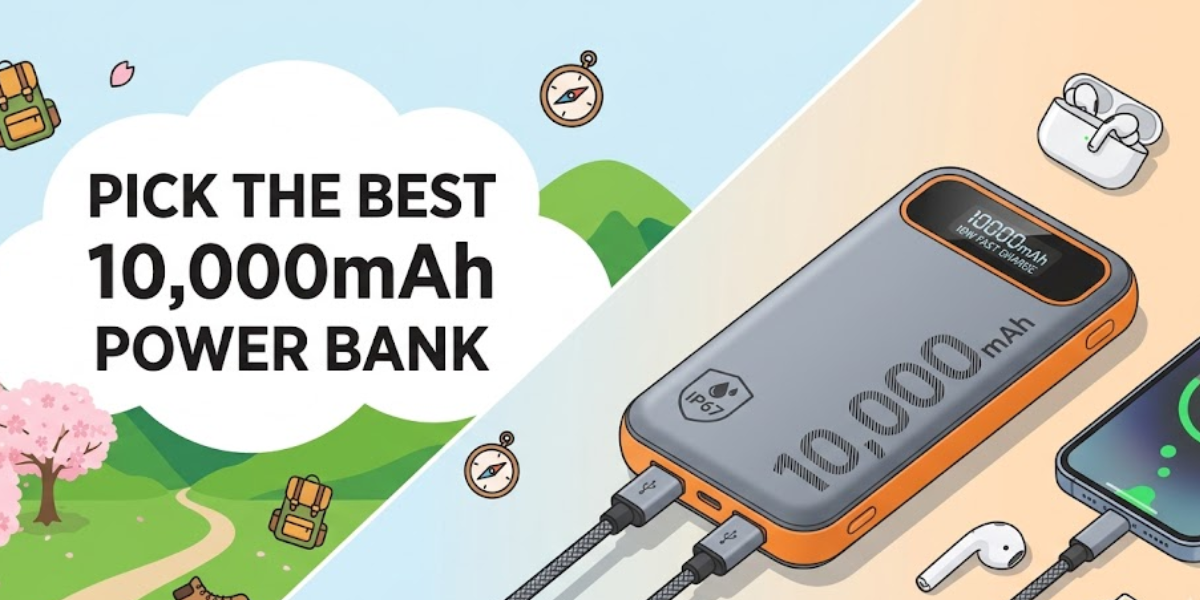
Forgetting the right power bank at home turns a perfect spring day trip into a dead-battery disaster. Keep reading to learn how to decode real-world charging capacity, pick the right ports and speeds for your devices, and spot durability features that actually protect your gear outdoors this spring.
Table of Contents
1. How Many Charges Will a 10000mAh Power Bank Actually Give You?
Most people see 10,000mAh on the box and assume they will get three or more full smartphone charges. The reality is less generous.
10,000mAh power banks typically recharge a modern smartphone up to three times on paper. But actual delivered capacity is roughly 40% less than the claimed number due to energy lost during voltage conversion. That means your unit is realistically closer to 6,000mAh or 7,000mAh of usable power.
To estimate your real yield, discount the claimed capacity by 40% before dividing by your phone’s stated battery capacity. On that basis, a 10,000mAh power bank gives most phones about two full charges, not three.
What drains your charge faster
Your phone’s operating conditions directly affect how many charges you actually get. Power-hungry habits eat into that usable capacity and shrink the number of full cycles from a single pack.
Things that drain power faster and reduce your effective charges:
- High screen brightness
- Active GPS navigation
- Cellular signal searching in poor-coverage areas
- Running multiple background apps while charging
2. USB-C, USB-A, and Built-In Cables: Which Ports Do You Actually Need?
Multiple output ports let you charge a phone, earbuds, and smartwatch at the same time without juggling extra cables. This is one of the most important features when choosing the best fast charging power bank for spring travel or day trips.
USB-C vs. USB-A output explained
USB-C is increasingly the default for new phones, earbuds, and accessories, while USB-A remains common for older devices and budget chargers. A power bank with both USB-A and USB-C output ports gives you maximum flexibility without needing adapters.
Look for at least one USB-C port that supports both input and output (passthrough charging). That same port can then recharge the power bank and charge your devices.
Why built-in cables reduce hassle
Power banks with built-in cables eliminate the need to remember a separate charging cord for every device. For spring outings where space and simplicity matter, this feature cuts pocket clutter significantly.
Built-in cables commonly come in USB-C, Lightning, or Micro-USB varieties. Choose a model whose built-in cable matches your primary device to lose one more thing to keep track of.
3. Fast Charging: What Speeds Should You Expect?
Fast charging depends on both the power bank’s output capability and your device’s input compatibility. Wattage alone does not guarantee faster speeds if your phone cannot accept a higher charge rate.
Output wattage breakdown
Most 10,000mAh power banks in 2026 offer output levels around 18W to 22.5W. Higher wattage generally means faster charging, but only when your device supports the corresponding fast-charge protocol.
If your phone maxes out at 18W input, a 10W power bank will never exceed 10W charging speed regardless of its claimed capacity.
Device compatibility checklist
Before buying, confirm your device’s maximum supported input wattage. iPhones, Samsung Galaxy models, and Google Pixels each support different fast-charge standards.
Matching your power bank output to your device’s input ceiling is the single best way to avoid overpaying for wattage you will never use.
4. Portability and Weight: Finding the Truly Compact Model
The best 10,000mAh power banks for spring travel fit in a jacket pocket or small bag and add minimal weight. Portability depends on more than capacity alone. Cell chemistry and construction matter just as much.
Comparing lithium-polymer vs. lithium-ion
Lithium-polymer cells are generally thinner and lighter than lithium-ion cells at the same capacity, making them better suited for compact, pocket-friendly designs.
Look for models under 200 grams with slim, rounded edges that will not dig into your pocket. Lighter models are easier to forget you are carrying, which is exactly what you want on a spring outing.
5. Dustproof, Waterproof, and Drop-Resistant: Outdoor Features
Spring adventures demand power banks that handle rain at festivals, dust on trails, and accidental drops while hiking. Durability varies widely, and the right protection level depends on how rough your plans are.
Understanding IP ratings
IP ratings (Ingress Protection) measure a device’s resistance to dust and water. A rating of IP67 means the unit is fully dust-tight and can survive temporary submersion, while IP54 protects against splashes and limited dust exposure.
For spring camping, hiking, and road trips, prioritize IP-rated rugged designs that can handle sudden rainstorms, dusty trails, and drops onto rocks. Check the manufacturer’s specs carefully, since not every model advertises an IP rating.
6. Airline-Approved Power Banks: What You Can Bring on a Plane
A 10,000mAh power bank is generally airline-approved for carry-on luggage, unlike higher-capacity models that may face restrictions.
Under IATA and TSA guidelines, 10,000mAh units fall well within the 100Wh carry-on limit, so you should have no trouble getting through security.
Power banks above 20,000mAh typically exceed airline watt-hour limits and may be confiscated, so always double-check capacity before flying.
Keep your power bank in your carry-on bag rather than checked luggage, as most airlines prohibit them in the cargo hold regardless of capacity. Printed capacity markings on the device can speed up security screening.
7. Price vs. Reliability
Cheap power banks often cut corners on safety, cell quality, and accurate capacity labeling. Mid-range models typically deliver the best combination of speed, longevity, and build quality.
Red flags in overly cheap models
Power banks priced far below market average frequently overstate their capacity, lack proper safety circuits, or use low-quality cells that degrade quickly.
Look for overcharge protection, temperature control, and clear watt-hour (Wh) labeling when comparing models. These details separate a dependable 10,000mAh power bank from one that dies after a few months.
How We Picked Our Recommendations
Our selections come from hands-on testing, verified user reviews, and direct comparison of efficiency, port selection, fast-charge support, ruggedness, and airline compliance.
We factored in real-world charging performance versus claimed capacity, since the 40% efficiency gap is one of the most common complaints buyers encounter. Reliability over months of use mattered more than a single impressive lab number.
Conclusion: Our Top Pick for Spring 2026
A compact, lithium-polymer unit with both USB-A and USB-C output, built-in cables, and a rugged, weather-resistant design covers the widest range of spring scenarios, from day hikes to long travel days.
From budget-conscious picks with at least 18W fast charging to fully loaded rugged models, use the criteria above to match the right 10,000mAh power bank to your specific spring plans.
Frequently Asked Questions
How many times will a 10000mAh power bank charge my phone?
Expect roughly two full smartphone charges in real-world use. Actual delivered capacity is around 40% less than the advertised number due to energy lost during voltage conversion.
Why does my power bank die faster than its advertised capacity?
Power banks lose capacity during voltage conversion from the internal battery cells to the 5V USB output standard. This efficiency loss makes real-world usable capacity significantly lower than the printed number.
Can I bring a 10000mAh power bank on a plane in 2026?
Yes. 10,000mAh power banks fall well within the IATA and TSA carry-on limit of 100Wh. Keep it in your carry-on bag rather than checked luggage.
What is the difference between lithium-ion and lithium-polymer power banks?
Lithium-polymer cells are typically thinner and lighter than lithium-ion cells at the same capacity, making them better for compact, pocket-friendly designs.
Do I need USB-C or is USB-A still fine for a travel power bank?
For maximum flexibility in 2026, choose a power bank with both USB-C and USB-A ports. USB-C is the default for new devices, while USB-A remains useful for older accessories.
